

Many factors affect how skin texture is rendered in photographs. Is the image taken in natural light? In a studio? Is the light “hard” or “soft”? How does the photographer edit the images afterwards? What kind of texture are we talking about? These are all relatively easy to answer technically, but I want to talk a little more generally about skin.
Human skin can have many different characteristics. We all have pores. For some people they are more visible, and for others less so. The surface of the skin is never completely smooth; there is always some kind of texture and possibly body hair. Skin colour and sheen also vary. Skin may have scars, wrinkles, moles, rashes, pimples or marks left by a skin condition, for example. These are all ordinary characteristics of skin, and they should not be thought of as flaws.
Images we see do not reflect reality
I have probably said enough times how the commercial image stream around us, and the filters fed by it on social media too, shape our idea of what is normal. Normal, surprisingly, is a completely textureless, porcelain-like, velvety skin, with its natural features erased without trace. The gap between the skin of a person looking in the mirror and the reality presented in different media is enormous. It creates a constant feeling of not being enough. Why can’t I achieve something that seems possible for so many others? Yet that sense of possibility is based on a lie.
Capitalist logic depends on consumers’ — that is, all of us’ — feeling of inadequacy, so that solutions can be sold to us. But what if, instead of solving feelings of inadequacy and inferiority by changing our appearance (whether through filters or more radically), we learned to relate neutrally to our skin, for example. I myself have wrinkles, acne scars, stretch marks, scars from accidents, enlarged pores, patches of psoriasis, occasional eczema, skin on my face that easily looks shiny with oil, visible veins beneath the skin, and uneven, often reddened skin. I am not very hairy and rarely even shave my body hair. Do I like the characteristics of my skin? Honestly, not really, but I can relate to them somewhat neutrally. I do not want there to be large differences between my reflection and the photographs taken of me. I do not want to hide or erase part of myself, and I certainly do not want someone else making that decision for me as if the characteristics of my skin were something so awful that they could not be shown in photographs. As a middle-aged person, I also want to be visible as I am. Ageing is a privilege.
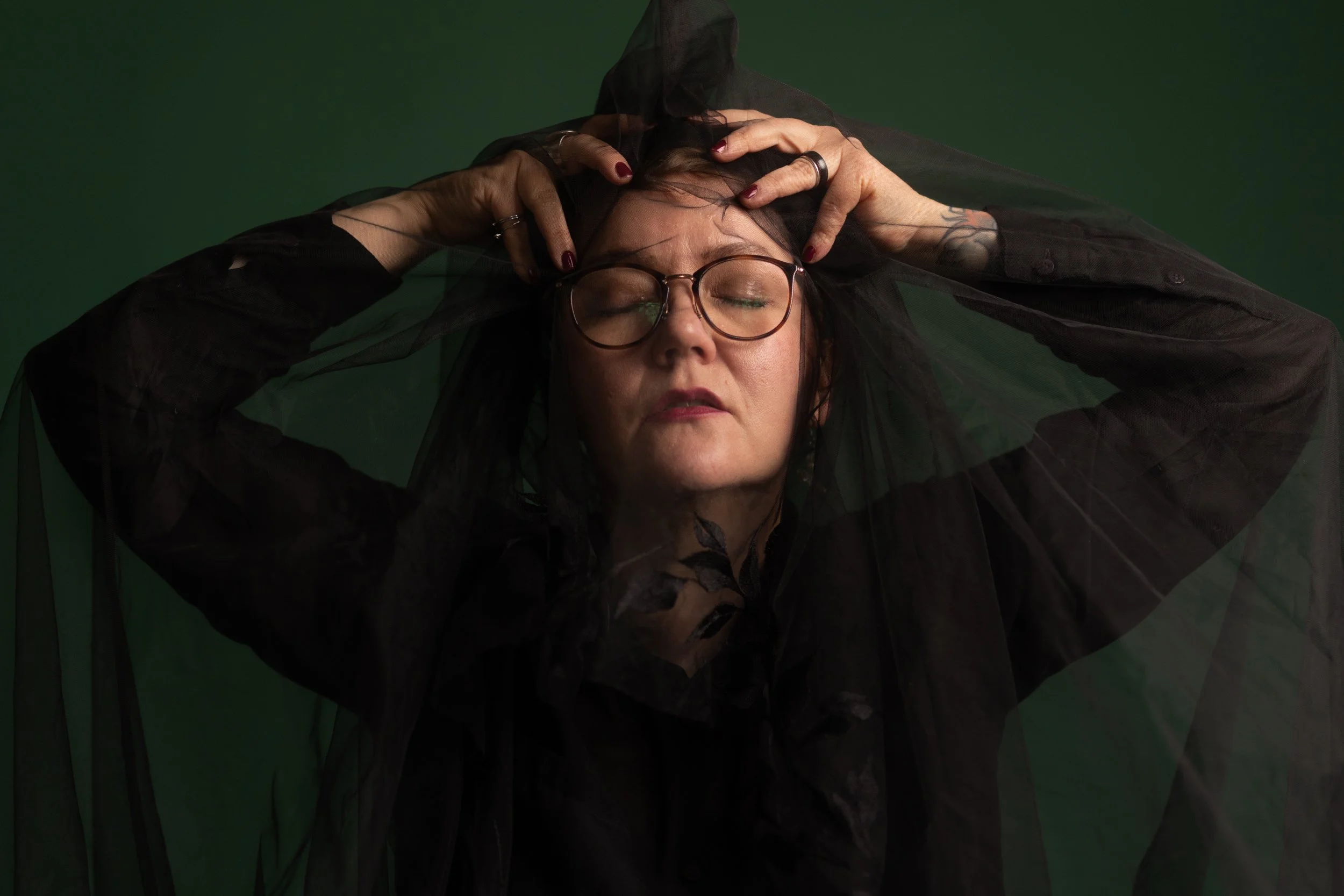
How do I, as a photographer, affect how skin appears in images?
As a photographer, I am still at the very beginning of my career, and I encounter a great many requests to smooth wrinkles, remove scars or heavily retouch skin. From the start, I have also said that I do not do radical edits. Of course, how skin texture appears in an image is also a question of shooting technique and editing. Flash light itself reduces skin texture, and I tell my subjects that too. In post-processing, I never radically enhance or soften anything. My images are relatively realistic. Nor do I deliberately place my subject under bright overhead light, which does no one any favours. I know what I am doing with light, and many of my subjects’ requests were based on the discomfort caused by photos taken in poor lighting. I always try to explain very clearly what the lighting does and what the final result in the images will look like.
In editing, the adjustments that affect skin most strongly are clarity, texture and contrast. The clearer, more textured and more contrasty an image is, the more strongly skin details will also be rendered in photographs. Conversely, the softer an image is processed, the less skin details will be rendered in photographs. These adjustments do not directly alter the features of the skin, and they affect the entire image if masks are not used. In more extreme processing, skin texture can be separated onto its own layer and removed entirely. I never do this kind of processing, but depending on the mood of the image, I may soften the whole image. In addition, it is possible to remove things from an image. However, I do not alter permanent characteristics of the skin. If a subject has a bruise, a contusion or some temporary skin condition, I can remove such things from images on request. In these situations, “temporary” is an essential concept.
I always tell my subjects that no characteristic of skin is a flaw or something to be hidden. I hope that, as humanity, we will eventually reach a point where we can allow ourselves and one another to exist in our bodies without value judgements or constant comparison to some unattainable “ideal” imposed from outside ourselves. Skin is the body’s largest organ, and it is constantly under the influence of the environment. Skin responds, ages, changes and adapts in incredibly beautiful ways.
— Tinksu